
AoIP and VoIP both have the common term ‘IP’ in their names. It stands for Internet Protocol, the technology that supports the exchange of media (files, audio, and video) over the internet instead of physical wires and cable framework. AoIP and VoIP are extensions of the IP technology and provide an alternative to the traditional analogue phone system. The differences between AoIP and VoIP lie in the type of data exchanged, the different industries that use each technology, the difference in internet bandwidth, and some other specifications.
The goal of this blog is to understand the definitions and working process of AoIP and VoIP and help you to distinguish one from the other.
What is VoIP?
VoIP is an IP technology that allows calls over an internet connection. Any device can be connected to the VoIP system either by using an Ethernet cable to connect it to the router or simply via a wireless internet connection. In addition to the major feature of voice calls, VoIP also allows advanced features like recording the call analytics, being able to forward calls within a system, queuing calls, and more.
VoIP offers clear quality for voice calls with minimum interruption, minimum data usage, and also international calls at a lower rate.
Compare VoIP Phone System Quotes Today
Understanding the Working of VoIP
To set up a basic VoIP system, three main components are required. The first one is the availability of internet (Wifi or mobile data), which is a non-negotiable requirement. Other than that, a subscription to a VoIP software for a hosted VoIP system is needed. Finally, a smartphone, laptop, tablet, or an IP deskphone is connected to the rest of the system to start making and receiving calls.
After the system is set up, the following process takes place to transmit the calls from one VoIP point to another:
- When a call is made, the voice signals are converted into digital signals.
- These digital signals travel to the VoIP service provider’s network via the internet. Here, the digital signals are converted into IP packets.
- IP packets are characterised by compressed data that allows for more data to travel within less bandwidth.
- Finally, the IP packets are decompressed to convert into voice signals that can be heard in clear quality at the receiver’s device.
- Both the compression and decompression are done via codec technology.
Major advantages of using VoIP

Hardware flexibility
VoIP calls can be made and received on any smart device with an internet connection. Businesses can either reuse their traditional deskphones as VoIP phones with a simple modification (attaching an ATA adapter), use software-based IP phones, or simply install the application on personal mobile phones, laptops or computers and get connected to the network. This enables the network to be remote as well, as employees do not need to plug their devices into a specific location for it to work.
Software-based scalability
The capacity of your VoIP connection depends on your business needs. A small business can deploy a VoIP network for a few users, making it ideal for a small team. When the team expands, more users can easily be added to the network without installing new lines or building infrastructure. Downsizing the number of users in a VoIP network also works similarly.
Capable of integration with business softwares
VoIP is capable of integrating with a business’s existing CRM, HRM, and ERP systems. This helps streamline all business operations in one place, where customer communication as well as internal team meetings take place over VoIP with the same software.
Get access to advanced features
VoIP offers advanced features other than simple audio and video calls. These include advanced call management, call routing and scheduling, collaboration tools, voicemail to text and email options, and international calling at cheaper rates.
Quick setup
VoIP is easier to set up compared to its traditional counterpart, landline phone systems. It has three basic requirements: an internet connection, a smart device capable of connecting to the internet, and a network router with QoS integration. A VoIP connection does not need a network of physical lines, so a lengthy installation cycle is instantly out of the picture. As a result, the setup is quick, easy and takes 1-3 days to start working.
What is AoIP?
AoIP stands for Audio over Internet Protocol. It is used to broadcast audio-only media, to provide high-quality audio. The audio quality offered by AoIP is even better than the VoIP voice calls feature because it is of professional grade. AoIP is largely used by broadcasting channels, radio stations, recording studios, and music distribution services.
Since the technology is used over the internet, it provides a far better alternative to traditional radio and landline audio distribution systems.
How does AoIP work?
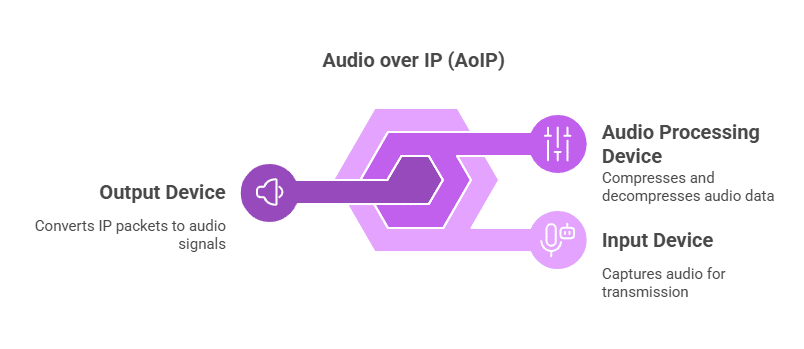
AoIP works similarly to VoIP, as both use the same pathway in which the analogue audio signals are first converted into digital signals. After that, the audio signals are split into IP packets, which travel via the internet to be transformed back to audio signals at their final destination.
Let’s take a look at the basic device requirements to set up an AoIP system:
- Device 1: The first device in the system would be an input device, like a microphone, where the audio is fed at one AoIP point.
- Device 2: Audio processing device that performs the compression and decompression process to convert the data into IP packets.
- Device 3: An output device, like a speaker, that converts the incoming IP packets into audio signals. The output device is also often built in with an amplifier.
Major advantages of using AoIP

High audio quality
The main functionality of an AoIP connection is its HD audio quality. As compared to the data that transmits over analogue systems, AoIP has lower jitter, minimal latency, and more reliable audio delivery. That is because AoIP systems are designed to operate on managed networks with QoS and clock synchronisation. It all depends on converting analogue voice signals into digital signals and sending them over IP networks in an AoIP system.
Less complex infrastructure requirements
Traditional telephony systems require a physical copper wire for a single connection, which can only be connected to a single device and utilised by a single user. This results in messy cables, multiple outlets, necessary hardware for each person in the team and extra clutter. However, in AoIP, one cable can carry hundreds of audio channels, which means an infrastructure with a neater layout and easy installation.
add or remove users Easily
Businesses can easily remove or add new users/ devices in an AoIP connection. First of all, confirm that the new device must support the same AoIP protocol as your network. Then, simply plug the device via an Ethernet cable into the same network switch. Once this step is completed, the new device should now be instantly discoverable and ready to transmit audio. Within the provided network limit, you can easily upscale or downsize the number of devices in an AoIP network.
Minimal audio disruption
Traditional audio networks use copper cables in their infrastructure, where the audio travelling through them is prone to electromagnetic disturbances and loses quality till reaching the other end of the connection. However, AoIP is IP-network dependent, which eliminates electromagnetic interference common in analogue systems.
Perfect for communication across long distances
AoIP supports audio transfer over long distances, inclduing accorss buildings or close locations. To prevent audio loss, audio is converted into digital IP packets, and hundreds of audio lines travel through the same cable. AoIP also transmits uncompressed audio, but its quality is not compromised to deliver HD audio to the other end of the connection.
VoIP vs AoIP: Summary of differences
| Factors | AoIP | VoIp |
|---|---|---|
|
Type of Data |
Transmits audio-only media. |
Transmits voice calls, with additional features. |
|
Audio Channels |
Uses multiple audio channels. |
Requires a minimum of one audio channel. |
|
Audio Quality |
Professional-grade audio quality. |
Clear but basic audio. |
|
Internet Bandwidth |
Requires high bandwidth. |
Requires less bandwidth as compared to AoIP. |
|
Main Users |
Used by radio stations, studios, and broadcasters. |
Used by businesses for internal and external voice communication. |
|
Usage examples |
For live audio broadcasting. |
For two-way communication. |
Key Differences between AoIP and VoIP

Let us now discuss the differences between the two technologies. Learning the difference between both is important because AoIP and VoIP are used for different purposes. Only then can you make the right decision for your business.
Number of audio channels
Audio channels are the number of audio streams traveling through a connection at a time. In the case of VoIP, usually one audio channel meets the requirement of a mutual conversation. Advanced VoIP systems can also support multiple audio channels, but a basic system can operate on a single one.
On the other hand, AoIP works on multiple audio channels, allowing for a high-quality audio output with each distinguishable sound. The different audio streams allow the audio engineers to mix, match, and edit them, which creates a comprehensive audio at the end.
Internet bandwidth needs
AoIP generally requires more bandwidth than VoIP, mainly because of the higher audio quality. The bandwidth requirement of AoIP depends on different factors, like the number of audio channels, codecs, and the extent of the audio quality.
VoIP calls require less bandwidth than AoIP because the audio is not meant for professional use. It also depends on the number of users in one system and the network traffic at a time.
Users of each technology
AoIP provides better audio quality than VoIP. That is the reason why AoIP is preferred by businesses mainly dealing with professional audio distribution. While, VoIP is widely used for daily communication within a business setting, either within a team or with outside customers.
VoIP vs AoIP: Which option to choose for UK businesses?
User instances for VoIP and AoIP are different, and it is important to choose according to the specific business industry and requirements. VoIP and AoIP both use IP networks, but serve different purposes. VoIP is designed for business communication (including audio, video, messages, text-based data, as well as other software integrations) while AoIP is purpose-built for professional audio transmission. Since AoIP works in only one audio department, it produces higher quality output as compared to VoIP or traditional telephony systems.
Choose VoIP if:
- You need everyday business communication (calls, video meetings, messaging) within the organisation and with customers.
- You have a remote team and a minimum capacity for storing heavy equipment.
- You are upgrading from a traditional landline phone system.
- You require good call quality, but not professional-grade HD quality is not necessary.
Choose AoIP if:
- Your business operates in any one of the sectors of radio & TV broadcast channels, music studios, theatres, live sound and conference centers.
- Your business requires high-quality audio distribution over long distances.
- Audio quality matters more than video calling, messaging and other features.
Upgrade Your Business Communication with ComparedBusiness UK
From internal calls to customer support, a reliable VoIP system can make all the difference for your business. At ComparedBusiness UK, we help you find cost-effective VoIP solutions made to your business needs. Share your details in under 2 minutes, and we’ll connect you with top VoIP providers across the UK.
FAQs
VoIP and AoIP both operate over the internet to send and receive their respective data. This is indicated by the term Internet Protocol in both terms.
Yes, these two terms are synonymous. There are many other terminologies used for the same technology, like Internet Audio Broadcasting or Audio over Ethernet. All of these are just different names for AoIP.
Yes, they do. VoIP can be used with simple devices like smartphones, laptops, or IP phones. AoIP, however, needs special equipment like audio interfaces and sometimes speakers with amplifiers to work properly.