
While often used interchangeably, leased line and dedicated line have some differences and this article will discuss just that. In a nutshell, they both offer uncontended and high-speed internet connectivity to businesses but are different in terms of their use cases and usage. Let’s get into it.
Key Takeaways
Leased Line: Point-to-point between locations: A leased line always connects two locations (e.g. your office to your ISP network), where the provider owns and manages all infrastructure.
Dedicated Line: A dedicated line can connect not only the physical locations but also cloud providers, CDNs, VPN providers and more. Ownership and infrastructure are your business’s responsibility.
Terms can be used interchangeably: The terms ‘direct internet access (DIA)’, ‘leased line’, and ‘dedicated line’ can be used interchangeably by providers for the same product. The differences lie in SLA tiers, pricing, and whether the circuit is fully dedicated at every point.
Core technology is different: Leased lines mostly rely on fibre optic cables. But dedicated lines can use multiple infrastructure options like copper wires, microwave signals and MPLS, depending on your service.
Leased lines offer stronger SLAs: Leased lines come with strict SLAs which cover service uptime, fault resolution and downtime. However, SLAs are not guaranteed in dedicated lines, and they depend on your chosen type of service.
Use ComparedBusiness UK to compare the top leased line providers.
Compare Leased Line Quotes Today
What is a dedicated line?

A dedicated line is a private, fixed communication channel reserved exclusively for your organisation or business. Unlike shared connections, a dedicated line offers unshared bandwidth.
They can be tailored to support various services such as dedicated internet access, cloud connections or virtual private networks (VPNs).
What is a leased line?
A leased line is also a private, fixed communication connection but it is rented from an internet service provider (ISP) to ensure a high-speed link between two locations. It provides symmetric bandwidth, meaning upload and download speeds are equal, which makes it perfect for data-heavy operations like video conferencing.
Dedicated lines vs leased lines: The differences
1. Connection
Leased lines are always used to connect 2 geographical locations e.g. a service provider and business site, while that’s not always the case with a dedicated line. A dedicated line can also be used to establish connectivity to network resources like an internet exchange, content delivery networks, data centres, VoIP providers and cloud service providers.
2. Infrastructure requirement
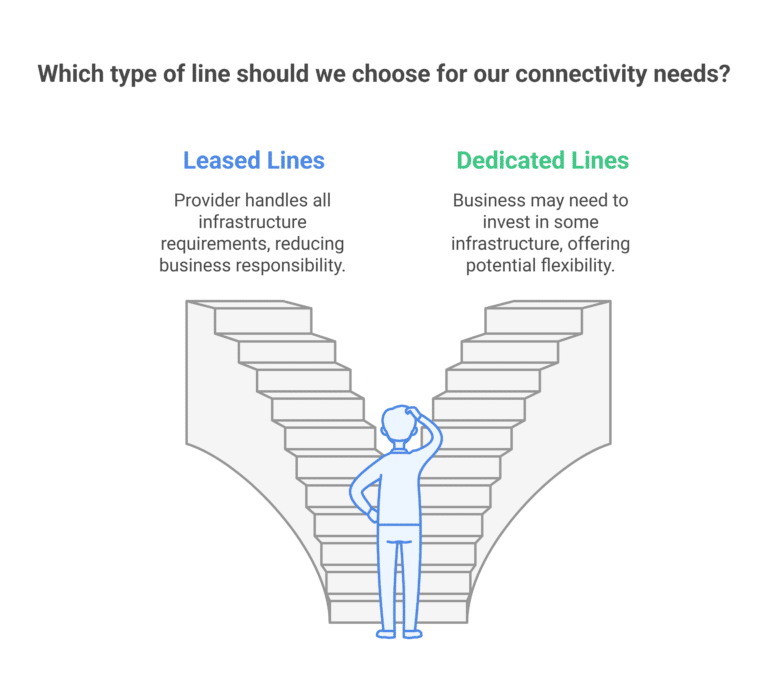
In the case of leased lines, the providers are always responsible for all the infrastructure requirements for establishing the connection. This pertains to trenching, site surveys, installing modems, attaching antennas, etc.
In the case of dedicated lines, the business may need to spend some money on infrastructure needs such as installing switches and cables in the office. Many dedicated line providers do offer this facility, though.
Want to know more? Read our detailed breakdown of leased line costs.
3. Ownership
Another difference between a dedicated line and a leased line lies in the ownership.
Leased lines will always be owned by the internet service provider (ISP) and will be rented or leased by the business, as evident from the name. But in the case of dedicated lines, the organisation might get ownership of the line. This, however, will depend on the contract between both parties.
4. Scope of services
Leased lines are typically used as a secure and private connection that is rented for a fixed period to ensure a constant bandwidth between two specific sites. In the case of dedicated lines, while they also provide unshared bandwidth, they can provide various services like dedicated internet access, dedicated cloud connections or dedicated VPNs.
The scope of services in dedicated lines surpasses that of leased lines, in simple words.
Read more about the advantages and disadvantages of leased lines.
5. Technology used
Leased lines usually implement fibre optic technology that provides high-speed and uninterrupted internet connectivity.
In comparison, dedicated lines may use other technologies e.g. copper wires for telephone services, microwave signals for dedicated wireless connections and MPLS for dedicated VPNs.
6. Service Level Agreements (SLAs)
One of the biggest advantages of leased lines is that they come with SLAs that guarantee uptime and speedy fault resolution. As far as dedicated lines are concerned, the nature of SLAs can vary depending on the service.
For example, dedicated internet access can have different SLA parameters while a dedicated line connecting to a cloud service from the same provider might have different clauses.
Dedicated lines vs leased lines - Table of comparison
| Feature | Leased line | Dedicated Line |
|---|---|---|
|
Connection |
Connects two geographical locations (e.g., a service provider to the business site).
|
Can connect to various resources like data centres, cloud services, or VoIP providers.
|
|
Infrastructure |
Provider handles all infrastructure (e.g., trenching, modems, antennas).
|
Businesses may need to invest in internal infrastructure like switches and cables.
|
|
Ownership |
Always owned by the service provider and leased to the business.
|
Ownership can vary based on contract; the organisation may own the line.
|
|
Scope of services |
Provides private, secure connections with fixed bandwidth between two sites.
|
Offers broader services like dedicated internet access, cloud connections, or VPNs.
|
|
Technology used |
Primarily uses fibre optics for high-speed, uninterrupted connectivity.
|
Can use fibre, copper wires, microwave signals, or MPLS depending on the service.
|
|
Service Level Agreements (SLAs) |
Includes SLAs guaranteeing uptime and fault resolution. |
SLAs depend on the service type, e.g., internet access vs cloud connections.
|
|
Scalability |
Flexible scalability, depending on the provider capacity |
Depends upon the network equipment of the organisation |
Also, read other comparisons of Leased Lines:
Leased Line vs VPN: A detailed comparison
Are Dedicated Line and Leased Line the Same Thing?
No, dedicated lines and leased lines are not the same technologies, even though they have some similarities. Both terms are usually used interchangeably, so that might create confusion among readers. In addition, they also offer private, high-speed connections, but that’s about it in the ways they are similar. The differences between them are in their functionalities, ownership and infrastructure.
A leased line is always from one point to another (between two locations) and is fully owned by the ISP. However, a dedicated line can connect to multiple resources, and ownership depends on the type of contract. If you are unsure which technology a provider is referring to, clarify about the service and its properties before signing an agreement.
Leased Line or Dedicated Line: Which One is Right for My Business?
The answer to this question of whether you choose a leased line or a dedicated line depends on your business requirements. That is because the nature of the connection you choose depends on your company’s connectivity needs.
If you require a reliable and high-speed connection between two fixed locations (between two of your office locations or your office and your ISP), then a leased line is a more suitable option. You can enjoy guaranteed SLAs, symmetric upload and download speeds. The infrastructure is also fully managed by the provider in this case. A leased line connection can meet your data-heavy needs, like sending and receiving large data files, video meetings, and more.
In another scenario, if your business needs to connect multiple resources and manage them, then a dedicated line is a better option. For example, managing cloud platforms, data centres, or VPN providers all run smoothly on a dedicated line. However, before choosing this option, consider that you might need to invest in additional infrastructure for dedicated lines.
Explore Reliable Leased Line Providers In The UK With ComparedBusiness
ComparedBusiness can help you link with the top leased line providers in the UK. Just submit your requirements in less than 2 minutes and we will match you with the top service providers in the UK. You can pick and choose the best option as per your business requirements. This service comes to you at no cost.
FAQs
The internet service provider (ISP) controls a leased line. The business renting the line has exclusive access to the bandwidth, but the ISP owns, manages and maintains the infrastructure.
Yes, a leased line can be called a dedicated line because it provides exclusive, unshared bandwidth for the business renting it. However, “dedicated line” is a broader term that may include other types of connections.
The main disadvantage of leased lines is their cost. They are more expensive than shared connections, especially for small businesses, due to the exclusive bandwidth and infrastructure maintenance by the ISP.