
Many industries in the UK have a long average sales cycle. This means there’s often a considerable gap between when a business makes a sale and when it actually receives payment. That gap can stretch to 15, 30, 60, or even 90 days. During this period, funds remain tied up in unpaid invoices or delayed payments. Meanwhile, the business still needs capital to manage daily operations, pay employees, cover ongoing costs, and take on new clients. That’s when companies turn to invoice-related financing solutions such as invoice discounting, which allows them to unlock cash early and improve their cash flow.
In this blog, we’ll discuss what invoice discounting is, how it works, its costs, an example, and its pros and cons. By the end, you’ll understand why many UK SMEs use invoice discounting to access advance funds and manage urgent expenses.
Key takeaways
- Get access to a cash advance: Invoice discounting lets you unlock 70%-90% of your unpaid invoice value at once after products/services are delivered.
- Invoice discounting fee: The discount charge is typically 1%-3% of the invoice value.
- Additional invoice discounting costs: These include service fees (1%-2% of the total invoice value) and setup fees, audit fees, and early termination charges.
- Eligibility requirements: You generally require a minimum annual turnover of around £250,000 for only B2B invoices.
- Volume of invoices: Whole turnover facilities (higher volume of invoices) cost less per invoice than selective invoice discounting.
Compare Invoice Financing Quotes Today
What is invoice discounting?
Invoice discounting, also called invoice financing or accounts receivable financing, allows businesses to trade their unpaid invoices in exchange for an upfront cash advance worth 70% – 90% of the total invoices. These extra funds provide a temporary boost to the business’s cash flow cycle, which may have been disrupted by factors such as long payment terms, slow-paying customers, or a high number of outstanding invoices.
For this service, a discount fee is charged at the rate of 1% – 3% of the total invoice value. In addition to this main fee, invoice discounting providers may also apply other charges, which we’ll discuss next.
How does invoice discounting work?
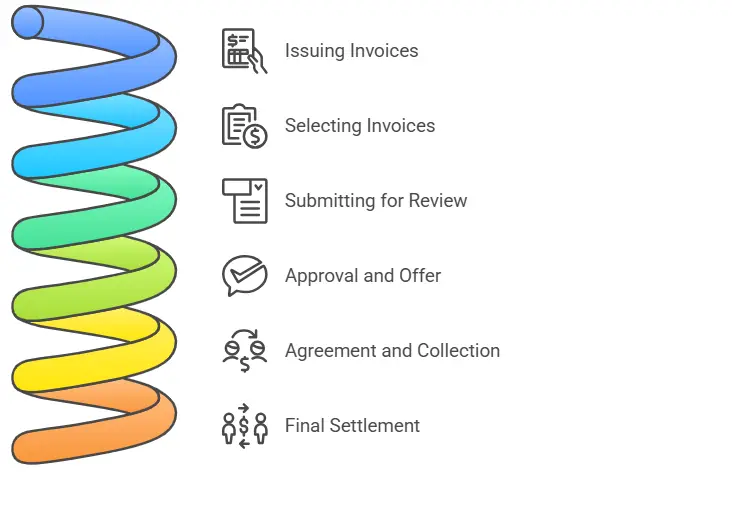
Six simple steps, from start to finish, explain the process of invoice discounting. In this explanation, the term ‘business’ refers to the company seeking a financial solution, which is the client of the invoice discounting provider.
Step 1: Issue invoices to customers
The business issues invoices to its customers as part of its regular operations. These invoices must be complete, meaning the services or products listed have already been delivered.
Step 2: Select invoices to finance
The business then decides the number of invoices that must be financed in exchange for an advance sum.
Step 3: Submit chosen invoices for review
The chosen invoices are submitted to the invoice financing provider for a simple screening process. The provider reviews the validity and age of the invoices.
Step 4: Provider approves the invoices
Once the invoices are approved, the provider proposes the advance percentage it offers upfront, along with the exact discount fee.
Step 5: Finalise contract and start collection
If the proposed rates are compatible with the business’s budget, both parties agree to the terms, and a contract is finalised. The business continues to collect the invoice payments from its customers.
Step 6: Final settlement
After all customers have cleared their invoice payments, the remaining 10% – 30% of the total invoice value is transferred to the business, minus the discount fee and any other applicable charges.
If you want to keep your financing arrangement private from your customers, then learn more about Confidential Invoice Discounting and how it works.
Invoice discounting costs
The major invoice discounting cost is the “discount fee”. It is the service fee charged for providing advance cash to the business before the invoices are completely paid by its customers. It’s how providers make the service profitable, typically charging between 1% and 3% of the total invoice value.
The exact discount fee depends on factors like:
- The reputation and reliability of the business.
- The creditworthiness of the business’s clients and their payment history. Finance companies view clients with a strong record of timely payments as lower-risk and vice versa.
- The years of experience of the business in its industry.
- Whether the business is dealing with other loans or existing financial commitments.
- The business’s average monthly invoice volume determines its financial stability.
Learn more about invoice discounting costs in our detailed guide.
Additional invoice discounting charges

In addition to the primary discount fee, finance companies may charge other fees for providing invoice discounting services, such as:
Service fee
It is charged as a fixed monthly or annual charge that covers the administrative costs of assigning account managers, managing the account and keeping invoice records, regardless of the invoice volume. It generally ranges from 1% to 2% of the total invoice value.
Audit fee
This includes the initial administrative fee to cover the costs of the period during which the financing provider verifies the invoices financed to check their legitimacy.
Set up fee
It is a one-time, upfront fee charged at the beginning of the arrangement to cover the cost of setting up the contract, along with the associated legal and administrative work.
Early termination fee
Most invoice discounting arrangements are contract-based. The contract durations range from a minimum of 3 months up to 12, 24, or 36 months. Leaving the contract early without notice can result in a termination fee, so check the notice period before signing up.
Non-recourse fee
Invoice discounting can either be recourse or non-recourse, depending on the specific agreement details. A recourse agreement entails that the business itself will cover any bad debt (the customer fails to clear the invoice). However, a non-recourse agreement means that the factoring company protects the business from bad debts and absorbs the cost of any customer invoices that go unpaid. A non-recourse facility carries an additional charge because of the higher associated risk for the lender.
Invoice discounting costs example
To understand the total cost, consider a business that receives a 90% advance on a £2,000 invoice. The provider offers a 2.5% discount fee after verifying the invoices financed. Once the customer pays the full £2,000 invoice, the provider calculates the final settlement. They deduct the total fees from the 10% that was not advanced and transfer the remaining funds to the business at the end of the contract.
Do you manage an accountancy firm? Then our Invoice Discounting for Accountants Guide is a perfect match for you.
Advantages and disadvantages of invoice discounting
Let us look at some advantages and disadvantages of invoice discounting:
| Benefits of invoice discounting | Drawbacks of invoice discounting |
|---|---|
|
Advance cash funding |
Temporary solution to financial problems |
|
Retain the privacy of financial arrangements |
Not suitable for smaller-scale businesses |
|
Maintain control over client management |
|
|
Affordable compared to other options |
|
|
Improved customer relationships |
|
Read more about the Advantages and Disadvantages of Invoice Discounting.
Benefits of invoice discounting
Invoice discounting offers the following benefits for businesses:
Advance cash funding
Invoice discounting allows businesses to get access to cash that otherwise would have been stuck in late invoice payments. Business sectors like architecture, healthcare and infrastructure have multiple parties within a single business sale and deal with problems like late payments and 60-90-day invoices. In such cases, invoice discounting acts as the ideal solution to speed up the payment process without interfering with the invoices themselves.
Privacy with financial strategies
This method provides a confidential source of working capital, as your customers are not aware of the financing arrangement. Your business’s financial team maintains complete control over the sales ledger and communicates directly with clients for all payments. This proves to be critical for well-established businesses that wish to protect their market image and manage their cash flow discreetly.
Control over invoice collections
Invoice discounting allows your business to retain full control of your own sales ledger and payment collection process. You manage all your customer interactions and payments directly. If you dislike outsourcing your client management, then invoice discounting is the right option for you.
Affordability
As a financing tool, invoice discounting is generally the more cost-effective option compared to other lending options like traditional bank loans or merchant cash advances. The fees are typically a clear percentage of the invoice value funded, so you know clearly how much to pay upfront.
Improved customer relationships
With invoice discounting, your customers continue to pay you directly as usual, with no third-party involvement. Getting access to cash funds helps you manage your business expenses efficiently and focus on ongoing operations, as well as facilitating new clients. This helps you strengthen your customer relationships and client management when you unlock cash from your invoices early on, without taking any loans and shortening invoice durations.
Drawbacks of invoice discounting

Like any financial service, invoice discounting also has some disadvantages in addition to the benefits it provides. Let us discuss these one by one.
Temporary solution
Invoice discounting is designed to manage temporary cash flow gaps but not to solve long-term financial losses or major expenses. It provides an upfront amount of funds based on the sum of invoices funded, which is suitable for bridging short-term working capital needs. It can mask more significant financial challenges if not managed carefully.
Not suitable for smaller businesses
This service is typically targeted towards established businesses with a sizeable average monthly revenue. That is because invoice discounting providers usually have minimum turnover requirements and prefer companies with a strong position. For many smaller-scale businesses, it might get difficult to meet such conditions.
Invoice discounting vs factoring
Invoice factoring is another invoice-based financial solution, often discussed alongside invoice discounting. Both of these are invoice-based, but they are significantly distinct from each other. Here’s how they differ:
- In invoice factoring, the business completely sells the unpaid invoices to the factoring company in exchange for the upfront advance funds. The ownership of the invoices, along with the administrative tasks of collecting pending payments from the customers, gets transferred to the factoring company. The provider bears a higher level of responsibility in this case, resulting in higher charges of 3% -5% of the total invoice value.
- In invoice discounting, the business retains the complete ownership of the invoices and continues to oversee the invoice collection process as usual. The financing provider is only responsible for providing the funds at the start and managing the in-house contract. It does not interact with the customers of the business directly.
Compare features here: Invoice Discounting vs Invoice Factoring.
Explore Top Invoice Discounting Options in the UK with ComparedBusiness UK
ComparedBusiness UK can help you secure invoice discounting from the top vendors in the UK. Just submit your requirements in less than 2 minutes, and we will match you with the top invoice discounting lenders in the UK. You can pick and choose the best option as per your business requirements.
FAQs
Yes, in most cases, invoice discounting is cheaper than invoice factoring. That is because the business continues to manage its own credit control and invoice collection in an invoice discounting arrangement. However, in the case of factoring, the factoring company takes over that work for the business, which increases their costs and running costs for payment collection services.
That depends on your contract and the provider’s terms and regulations. Generally, you can not exit an invoice discounting agreement without a 3-month notice, and some might have a longer notice period of up to 12 months. However, if you leave without fulfilling the prior warning requirement, it may result in penalty charges. If you do not want to be locked up in a long-term contract, always review the termination terms carefully before signing.
In a recourse agreement, the business is liable if a customer does not fulfil their invoice. In a non-recourse contract, that risk is transferred over to the provider. That is why non-recourse costs more because the lender is taking on that additional risk.
It might be difficult for startups or small businesses to access invoice discounting because of the minimum turnover requirements. Instead, such businesses should go for selective invoice discounting to finance a portion of their invoices and not the whole ledger.