
What is Invoice Factoring?
Invoice factoring (debt factoring or accounts receivables factoring ) is a financial agreement in which a business sells its invoices (also called account receivables) to a factoring company at a discount. With invoice factoring, a business gets access to immediate cash flow instead of waiting for months for the invoices to get paid.
Key Takeaways
- Invoice factoring gives you immediate cash access: Invoice factoring lets you access up to 80-90% of your invoice value within 24-48 hours. No need to wait for 30 or 90 days.
- Factoring fees range from 3-8%: The discount rate charged by the factoring company depends on factors like your industry, client credit worthiness, invoice volume, and how long customers take to pay.
- Your clients’ payment history affects rates: Factoring companies decide their fees based on risk assessment. Your chances of lower factoring fees would be higher if your clients are reliable.
- Types of invoice factoring: The types of factoring include recourse, non-recourse, spot and confidential factoring. The right type depends on your business size and industry.
- Avoid additional costs: You may encounter late invoice fees, collection service charges, annual renewal fees, and early cancellation penalties. Always read the agreement carefully to watch out for them.
- You can lower your factoring costs: Invoice creditworthy clients, keep your invoices dispute-free and compare multiple quotes to secure better invoice factoring rates.
We can Help you Compare Invoice Factoring quotes Today
How Does Invoice Factoring Work? A Simple Step-By-Step Breakdown
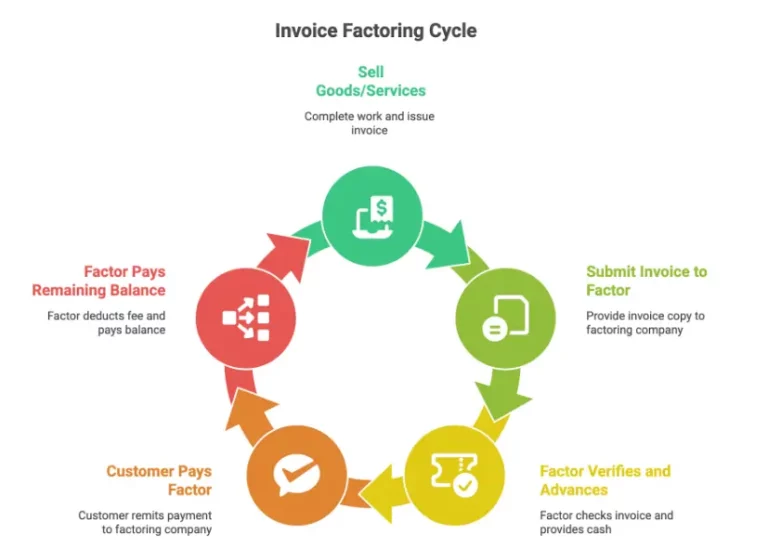
Invoice factoring works by working with a specialised factoring company who buys your unpaid invoices for immediate cash.
Here is the simple step-by-step process that will get you paid in days:
Step 1: You Sell Goods Or Services And Raise An Invoice
When you complete your customer’s work and raise an invoice, instead of waiting 30, 60, or 90 days for payment, provide a copy to a factoring company.
Step 2: Factoring Company Verifies And Provides Cash Advance
The factoring company then runs a verification to confirm that the invoice is valid and your customer is creditworthy. Once approved, they will usually forward you 80 to 90% of the invoice amount. This amount comes directly into your bank account.
Step 3: The Factoring Company Receives Payment From Your Customer
The factoring company manages the collection process. Based on your disclosed or non-disclosed conditions, the factoring company instructs your customers to remit payments to them according to the original invoice terms.
Step 4: The Factor Pays You The Remaining Amount
Once your customers make a full payment for the invoice, the factoring company subtracts their pre-agreed factoring fee and then forwards you the remaining balance.
Only work with the best invoice factoring companies in the UK offering the most competitive rates as of 2026. We have compiled a list for you here: Top 9 invoice factoring companies in the UK.
Cost of Invoice Factoring
These two major factors determine the cost of invoice factoring.
1. Factoring fees
Also called a discount rate or factor rate, this fee is the cost of the factoring services provided by the factoring company. The factoring fee is calculated as a percentage of the total costs of all the account receivables. Factoring fees can vary from 3–8% of the overall value of the unpaid bills.
This factoring fee can be charged weekly, monthly, or annually, depending on the conditions of your agreement.
2. Upfront cash value
Relationship Between Advance Rate and Factoring Fee

There is no direct relationship between these two. You might be thinking that if a factoring company offers a higher advance rate, will they charge a higher fee too? The answer is yes and no.
- A factoring company that offers a high advance rate is taking on more risk. If the client fails to pay the pending bill, the factoring company will be at a disadvantage because they have already paid out a significant portion of that invoice to you. To account for this increased risk, they might charge higher factoring fees. However, this isn’t a rule.
- The factoring market is competitive, and fees are influenced by what other factoring companies are offering. Some companies might offer higher advance rates without higher fees to remain appealing to businesses.
- Factor fees and advance rates are affected by many other factors, which we’ll talk about in detail further.
Invoice Factoring Cost Example

Let’s consider an example of invoice factoring. Make sure you understand advance and factor rates before we talk about what other factors affect the cost of invoice factoring.
Imagine you’ve issued an invoice for £10,000 payable in 30 days but need cash sooner. You opt for invoice factoring, where a factoring company offers a 90% advance rate and a 5% factoring fee. You receive £9,000 upfront (90% of the invoice). When your client pays the full invoice amount (£10,000) to the factoring company, they deduct a 5% fee (£500), and you receive the remaining balance of £500 at the end.
Are the invoice factoring costs even worth it? Get the answer within this guide: Is invoice factoring good for your business?
Factors Affecting the Cost of Invoice Factoring
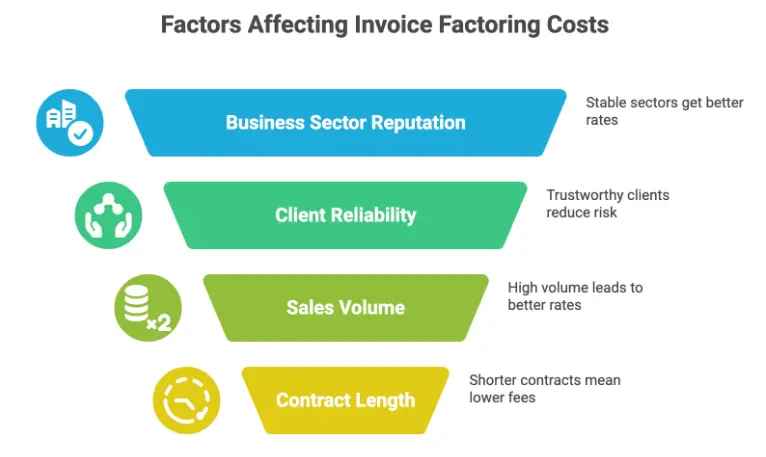
Factoring companies consider the strength of your invoices before getting into an agreement. There are a lot of factors to consider when evaluating your invoices.
Reputation of your business sector
Different types of businesses have different client bases and reputations, which can affect both the advance rates and the factoring fees. For example, healthcare or pharmaceutical industries in the UK, which are known for stable and reliable payments, might enjoy higher upfront cash and lower factoring fees.
On the other hand, businesses related to the construction sector in the UK can get very different rates. In this sector, invoices involve multiple clients with long-term contracts. There can also be disputes over project completion among different parties, and late payments are also more common.
History of your clients and how reliable they are
Factoring companies prefer low stakes. If your business has a good relationship with your clients, there is a high probability that they’ll pay the pending bills on time; hence, your factoring company will see it as less risky. If your business has trustworthy regular clients with a good credit history, then you are most likely to get lower rates for factoring and a large portion of your invoice value upfront.
Fixed minimum sales and amount of invoices
The amount of business you bring to the factoring company matters. If you have a high volume of invoices, you can get better rates. Some factoring companies also require businesses to have a fixed minimum of sales. This is to make sure the business is in a healthy financial state.
Length of contracts with your clients
The factoring fee increases with the length of the factoring period—that is, the time from when you factor your invoice until your customer pays it in full. If your customer pays the invoice within 30 days, you’ll face a lower factoring fee compared to a scenario where the customer takes 90 days to settle the amount. This reflects the increased risk and financing costs for the factoring company over longer periods.
But what makes businesses choose invoice factoring? It’s not just about the costs; many companies use it to manage their cash flow and keep up with the payment cycles. To better understand why invoice factoring is so popular among different industries, check out the video below.
Additional Invoice Factoring Costs
Keep in mind that these invoices are not always explicitly mentioned in your contract with the factoring company. We advise that you carefully read the conditions of your agreement. It’s always better to ask any questions beforehand to avoid surprises later.
Late invoice fee
A factoring company would want to minimise its financial stake. If a customer fails to pay the pending money for an invoice on time, the factoring company can try to charge you an overdue or penalty fee.
That’s why it is advised to read your factoring agreement carefully and see if there is anything mentioned related to it. Even if there’s nothing explicitly mentioned, ask your factoring company about their strategy if a client doesn’t pay on time.
Collection services charges
A factoring company uses its resources to collect payments from your clients, which is usually covered by the factoring fee. However, some factoring companies can charge you separately for their management and execution.
This is beneficial for small businesses because it saves them from having to chase after payments themselves, instead, they can pay a small amount to the factoring company to collect their invoices.
Annual fee
This is not a common fee, but it can be applicable in some cases. If you have worked with a factoring company for more than a year, they might charge you an annual fee or a fee to renew your factoring contract.
Penalty for early cancellation of the agreement
If you discover a provider offering to purchase your invoices at more favorable rates, or if you decide to go in a different direction, you should have the flexibility to terminate your contract at any point. Some factoring companies try to trap businesses in long-term contracts with a penalty if you cancel the contract before it ends.
Still contemplating whether invoice factoring is the right option for your business? Read here: 6 reasons why companies choose factoring and see if any resonate with you.
How To Lower Your Invoice Factoring Costs?
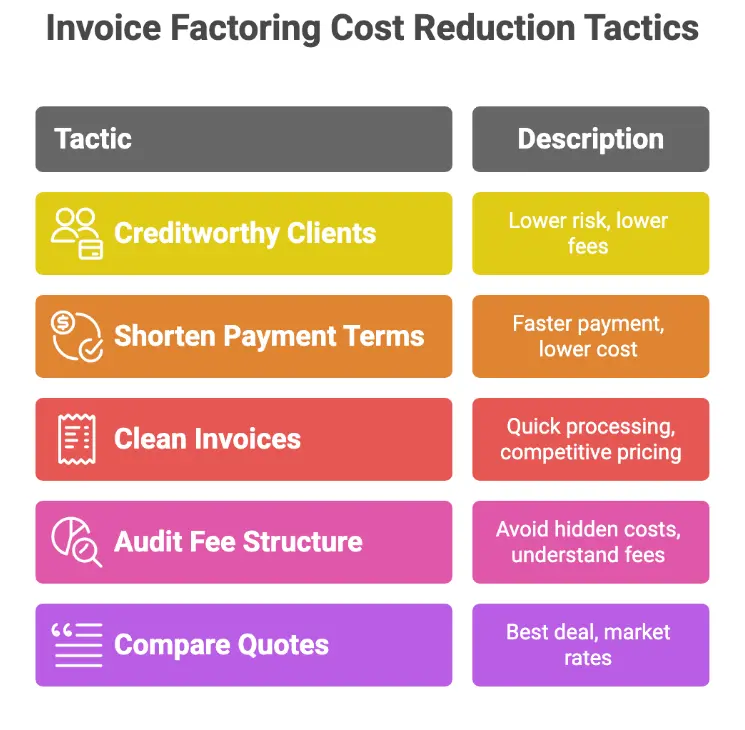
The cost of factoring is not fixed. The fees you pay are the end result of your business decisions and strategic choices.
Here are some actionable tactics to get better rates and retain more revenue:
- Invoice Creditworthy Clients: The cost of invoice factoring is based on the risk. The lower the risk, the lower the fees. Submit invoices for creditworthy customers to reduce the cost of the factoring fee.
- Shorten Payment Terms: It costs less to factor a 30-day invoice than a 90-day one.
- Maintain Clean Invoices: Invoices that are clear, correct and dispute-free are processed quickly and priced competitively.
- Audit The Fee Structure: Avoid hidden costs; enquire about service fees, factoring fees and additional fees before signing a contract.
- Compare Multiple Quotes: Rates vary widely. Be sure to get 3 to 5 quotes to make sure you are getting the best deal on the market. To make this process easier, you can use ComparedBusiness UK to help you find the best invoice factoring company.
Types Of Invoice Factoring
There are several different types of invoice factoring. Which one is best for you will depend on your industry, customer base size, and preferences for customer communication.
The table below compares the most popular forms of invoice factoring.
| Type | How It Works | Best For | Key Advantage |
|---|---|---|---|
|
Recourse Factoring |
After a certain period (90 to 120 days), you are liable to pay if your customer does not pay the invoice. Advances must be reimbursed or an invoice substituted. |
Companies whose customers pay their bills on time, have good credit ratings and operate in stable industries. |
Lower fees: it is the most popular and economical invoice factoring method. |
|
Non-Recourse Factoring |
The factoring company bears credit risk for its customers. |
This service is particularly beneficial for companies that have recently acquired customers or operate in volatile sectors. |
Lower risk: mitigates bad debt. |
|
Spot Factoring |
You can factor one invoice or a small group of invoices as a single transaction without a long-term contract. |
Companies that experience intermittent cash-flow shortages or seasonal demand spikes can benefit from this option. |
Offers flexibility: no long-term commitments. |
|
Disclosed Factoring |
Your customer is notified that you have chosen to finance their invoice through a factoring company. |
This option is suitable for companies that do not have a direct relationship with their clients. |
The factor handles collections, which saves you time and energy. |
|
Undisclosed/Confidential Factoring |
The arrangement is confidential. Your customers are still paying you directly. |
This option is best for companies that want to keep their financial arrangements confidential. |
You have full control over your client relationship. |
Don’t want to hand over all your high-value invoices to a factoring company? Fortunately, you can pick and choose which invoice to factor with the option of Single invoice factoring.
Benefits Of Invoice Factoring
Invoice factoring is more than just financing; it’s a strategic cash flow tool. Here are the top advantages of invoice factoring for businesses:
- Immediate Cash Flow: Invoice factoring helps you convert your unpaid invoices to cash in just 24 to 48 hours. Pay the payroll and supplier payments and grab growth opportunities right away without worrying about unpaid invoices.
- Use Your Customer’s Creditworthiness: Approval is based mostly on the creditworthiness of your clients, not your business’s credit score. Hence invoice factoring is a great financing tool for startups and small businesses.
- Outsourced Collections: The factor takes care of collections and credit checks as well as the processing of payments.
- No Additional Debit On Your Books: Factoring is not a loan, so it doesn’t generate debt.
Find The Best Invoice Factoring Providers With ComparedBusiness UK Today
If you want to avoid the hassle of comparing different invoice factoring companies, use ComparedBusiness UK. We do all the hard work and help you find the best invoice factoring company that fits your business needs.
Get in touch with us to find the ideal invoice factoring company.
Get instant cash against your unpaid invoices within the next 48 hours. Compare top invoice factoring companies to choose the best option and get started today.
FAQs
Factoring fees are usually charged as a percentage of your total invoice value (3% to 8%). This fee is also called a discount rate.
The advance rate is the percentage of your invoice that the factoring company gives you at once. This typically ranges from 70% to 90%. The advance rate depends on factors such as your business type, the creditworthiness of your customers, and your company’s history.
Yes, factoring fees can sometimes be negotiable. The factoring fees depend on your business’s financial health, your client’s payment history, and the number of invoices you’ll factor. It’s best to always compare offers from different factoring companies before making a decision.
Yes, there can be additional costs like late invoice fees, collection service charges, and annual fees. Some factoring companies also charge a fee if you cancel the contract before the agreement ends. It’s important to read the agreement thoroughly and ask the factoring company about any potential hidden fees before signing.